City Bike Racer: Traffic Rush
- 4.4
- Rating
- 1.00M
- Installs
- Free
- Price
 Analysis by App-foxy
City Bike Racer: Traffic Rush is the kind of mobile racing game I can pick up for a short break without needing to study a complicated control system first. I ride through city traffic on a motorbike, react to vehicles around me, and try to keep the run going while the road becomes increasingly demanding. That simple idea gives it an immediate appeal, especially when I want quick action rather than a long career mode or a heavily simulated driving experience.
After spending time with it, I see the game as a straightforward arcade racer from KingSpeed Game. It is free to play, aimed at Everyone, and available for devices running Android 7.0 or later. Its current version is 1.0.4, and the game has already passed one million installs. Those details make it easy to understand the intended audience: people looking for an accessible, casual motorbike game rather than a specialist racing simulator.
My overall impression is positive but specific. The strongest part is the immediate relationship between what I see and what I need to do: watch the road, judge gaps, and steer away from danger. The weaker side is that this simplicity can also limit the experience for players who want deep tuning, extensive progression, or a large selection of racing formats. It is best approached as a focused traffic-dodging game, not as a complete replacement for a full console-style motorcycle racer.
You May Also Like

 Blood Strike: 2.5 Anniversary
Blood Strike’s Loadouts Turn Every Drop Into a Tactical Gamble
A close look at Blood Strike’s custom loadouts: how fast access to signature weapons reshapes its battle royale rhythm, rewards preparation, and narrows the gap between fights.

 Pandora - Music & Podcasts
Pandora’s Music Is Easy to Start, but Harder to Recover
Pandora’s strength is its low-effort path from a seed to a station. Its weak spot is how much confidence it asks you to place in connection, setup, and quiet recovery.

 8 Ball Pool
 Is Built on Rivalries, Rematches, and Routine
A close look at the rivalries, rematches, shared routines, and unanswered safety questions that turn a quick pool match into a persistent mobile community.

 Samsung Music
’s Quiet Strength Is Playing What You Already Own
Its reach comes less from spectacle than from dependable access to a personal library. That simplicity is both the app’s strongest retention engine and its ceiling.

 AccuWeather: Weather Radar
AccuWeather Review: A Quick, Clear Forecast for Everyday Decisions
For everyday plans, the best forecast is the one you can understand quickly. AccuWeather makes rain timing, radar, and local conditions easy to act on, with a few trade-offs.

 Hill Climb Racing
Why Hill Climb Racing Still Turns Crashes Into One More Run
A tiny car, a bumpy hill and one more upgrade: Hill Climb Racing keeps resurfacing because its simple chaos makes every near-miss feel personal.
More From Our News Desk
View All News


How clearly the road and controls communicate
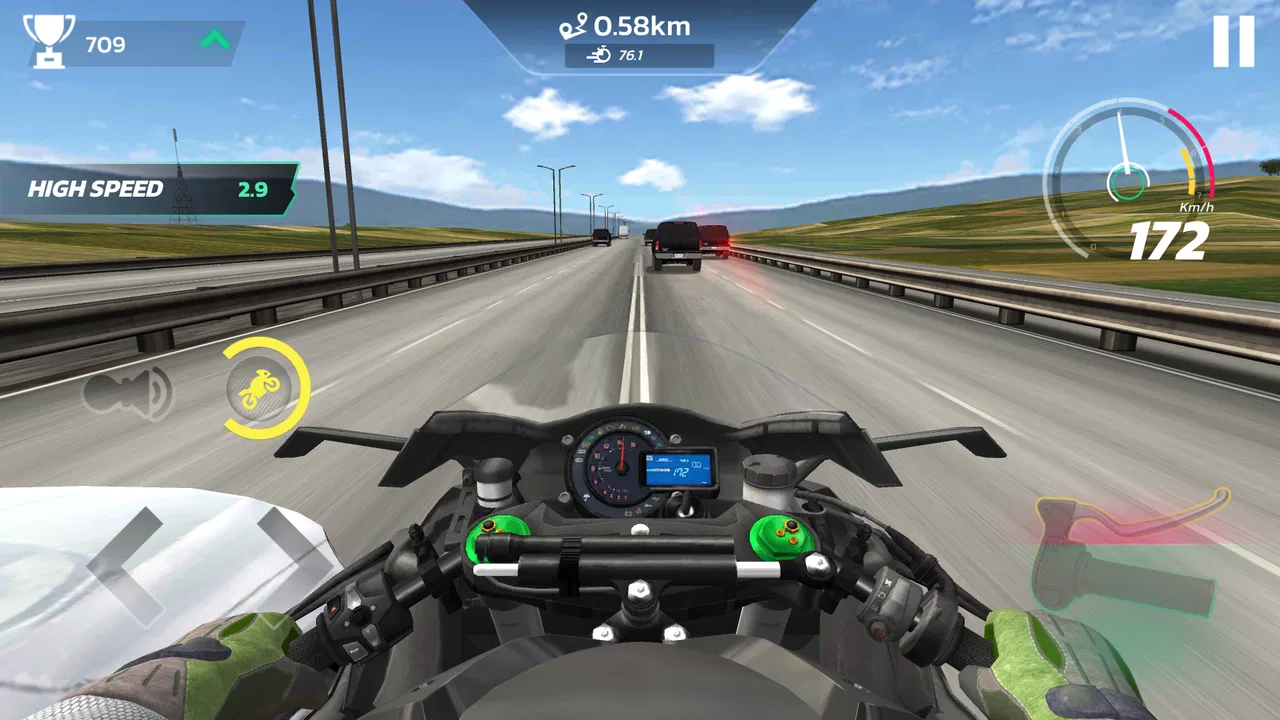
The first thing I noticed is that the game’s readability depends heavily on the road scene itself. Traffic racing only works when the player can quickly distinguish the bike, nearby vehicles, and the open space ahead. In practice, I found that the central task is less about memorizing menus and more about maintaining a steady visual scan. I keep my attention a little ahead of the bike instead of staring directly at its front wheel, because that gives me more time to react to vehicles entering my path.
That makes the game reasonably approachable for someone who does not usually play racing titles. There is no need to understand racing lines, tire grip, or a complicated garage before the main challenge becomes clear. The basic loop is visible through play: move through the city, avoid traffic, and protect the run. For a new player, that directness is more helpful than a screen crowded with technical information.
At the same time, visual simplicity should not be confused with effortless play. Traffic patterns can demand quick decisions, and a player who has difficulty tracking moving objects may find the road tiring after several attempts. I would recommend starting with short sessions and watching how comfortably the eyes follow vehicles from one side of the screen to the other. If the scene begins to blur into a mass of cars and road, taking a break is more useful than forcing another run.
Navigation outside the road is also important for a casual game. I prefer an experience where I can return to the action without repeatedly working through complicated layers. City Bike Racer: Traffic Rush benefits from keeping its central purpose obvious: this is about riding through traffic, not managing a large collection of menus. That makes it a good choice for a quick commute break or a few minutes while waiting, provided the player is comfortable with visual reactions.
One practical habit improved my results: I avoid making constant tiny movements. Instead, I look for a safe lane position, make one deliberate adjustment, and then reassess the traffic. This reduces frantic swiping or steering and makes the game feel more controlled. It is also a useful approach for players who find rapid repeated input uncomfortable, although the traffic can still require sudden corrections.
The rating gives the game a helpful signal for casual players. It holds a 4.4 average from around 1.3 thousand ratings, which suggests that many people find the basic experience appealing. I would not treat that number as proof that it suits every player, though. A rating cannot show whether someone prefers fast arcade reactions or a slower, more methodical motorcycle game. My own view is that the game communicates its purpose well, but its success depends on whether that purpose matches your preferred pace.
Why the simple layout helps some players
For players who are new to mobile racing, the lack of heavy simulation language is an advantage. You do not need to know what a racing setup should feel like before you can enjoy the central challenge. The road itself provides the immediate feedback: a clear gap invites movement, while a crowded lane warns me to wait or reposition.
This also makes the game suitable for informal shared situations. I can explain the objective to a friend in a few words, and they can understand the appeal without a long tutorial conversation. That is valuable for a game intended for Everyone, particularly when different people have very different levels of experience with mobile controls.
However, players who depend on large text, strong contrast, or highly adjustable interface elements should inspect the game on their own device before committing to long sessions. I can discuss the visual demands of the road, but I would not assume that every phone display presents the action equally clearly. Screen size, brightness, and viewing conditions can change the experience considerably.
Motor, sensory, and attention demands on the bike
The most important accessibility question here is not whether the game is difficult in an abstract sense. It is how much physical precision and sensory attention each run asks from the player. Traffic racing combines moving targets with directional input, so the hands and eyes work together continuously. I found that relaxed, deliberate movements are more sustainable than trying to react to every vehicle at the last possible moment.
Players with limited fine-motor control may find sudden lane changes demanding. A useful adjustment is to hold the device securely, rest the hands in a comfortable position, and avoid playing while walking or standing in a crowded place. The game is much easier to read when the phone is stable. That sounds obvious, but unstable posture turns an already reactive game into an unnecessarily frustrating one.
For someone who experiences hand fatigue, the short-session nature of the game can be a benefit. I can play one run, stop, and return later without losing the basic understanding of the controls. On the other hand, players who need slower input, remapping, or a less reaction-heavy format may prefer a different racing title. I would not choose this as my first recommendation for someone specifically seeking extensive control customization.
Sensory load is another consideration. Moving traffic, changing gaps, and the need to watch several objects at once can become intense even when the rules are simple. I personally play with the screen at a comfortable brightness and reduce distractions around me. A quiet environment helps because it lets me concentrate on the road rather than splitting attention between the game and surrounding activity.
Sound can influence how comfortable a racing session feels, but I would not rely on audio alone to understand what is happening. The essential information is visual: where the vehicles are and where the safe space appears to be. That means the game can still make sense when I play without depending on sound, although the visual concentration remains necessary.
Players who are sensitive to motion should also pay attention to their own response. A forward-moving road and fast traffic can feel more intense than a static puzzle or turn-based game. I recommend trying a brief session first instead of assuming that a motorbike theme will automatically be comfortable. If the movement causes discomfort, a slower racing game with less continuous visual motion would be a better choice.
A practical routine for more comfortable play
My preferred routine is simple. I begin with the phone at a readable angle, play for a short period, and stop when I notice that I am reacting late because of tiredness rather than because the traffic has genuinely become harder. I also avoid playing in direct glare, since reflections make it more difficult to distinguish a vehicle from the road background.
Another useful technique is to treat each run as a sequence of decisions rather than one uninterrupted reflex test. I look for the next safe opening, move toward it, and then reset my attention. This helps reduce the mental pressure of trying to predict the entire road at once. It is especially useful for beginners and for players who become overwhelmed when several vehicles appear together.
That approach also exposes one of the game’s trade-offs. The straightforward design makes it easy to start, but it leaves much of the burden on the player’s own pacing. A game with more explicit difficulty controls or accessibility settings could offer a gentler route for people who need slower reactions. Here, self-management matters: shorter sessions, a stable grip, and a clear screen can make the difference between enjoyable repetition and frustration.
Where it fits into everyday situations
I think the best use case is a short, focused break. Imagine waiting for an appointment with a few minutes free. City Bike Racer: Traffic Rush gives you an immediate activity without asking you to remember a long story or rebuild a complex setup. You can start concentrating on traffic almost at once, play until the moment no longer feels comfortable, and put the phone away.
It can also work as a casual introduction to racing games. Someone who finds realistic motorcycle simulators intimidating may appreciate the simpler goal of staying clear of traffic. The game does not require a player to understand professional racing techniques before having a chance to enjoy it. That makes it more welcoming than a simulation-heavy alternative for families or friends who simply want a quick competitive-style challenge.
Still, the Everyone age rating should not be read as a promise that every child will find the controls easy. Younger players may understand the objective quickly but still need time to develop the visual timing required to judge gaps. I would introduce it in a calm setting rather than handing it over during a busy car journey or while moving between activities. The road demands attention, even if the rules are easy to explain.
The game is less suitable when you need a low-attention background activity. I would not play it while listening closely to a lecture, crossing a street, or handling another task. Traffic dodging rewards concentration, and divided attention makes mistakes feel arbitrary when the real problem is the situation around the player.
It is also not the strongest choice for a long-term racing hobbyist who wants a detailed motorcycle garage, realistic handling, structured championships, or a broad multiplayer scene. Those players may be happier with a more specialized racing game. City Bike Racer: Traffic Rush earns its place through immediacy, not through a large simulation layer.
How it compares with familiar racing alternatives
Compared with a motorcycle simulator, this game feels more approachable because the focus is on surviving traffic rather than mastering realistic bike behavior. That is a meaningful difference for a player who wants action without studying braking points or vehicle setup. The compromise is depth: a simulator can offer more satisfying detail once the player accepts a steeper learning curve.
Compared with endless runners, the traffic format gives the experience a more recognizable driving purpose. I am not simply moving through obstacles in a fantasy lane; I am reading a city road and choosing openings between vehicles. Yet an endless runner may be better for someone who prefers one-touch input, stronger visual exaggeration, or a less realistic road setting.
Compared with a full arcade racing game, this title is more narrowly focused. That can be a strength when I want to get straight into traffic, but it may feel limited if I expect multiple event types or a substantial progression system. I would choose it for quick motorbike sessions and choose a larger racer when I want variety, customization, or a longer structured play session.
The free price lowers the barrier to trying it, which matters for uncertain players. I can test whether the visual pace and control demands suit me without treating the first session as a major purchase decision. Even so, free access does not remove the need to consider comfort. If the traffic view is tiring or the control style does not fit your hands, another free racing option may be a better use of your time.
Remaining barriers before you download
The main barrier is the game’s dependence on fast visual judgment. Players with slower reaction times, limited hand movement, or difficulty tracking objects may need to work harder than the simple premise suggests. That does not make the game unsuitable for everyone with those experiences, but it does mean I would approach it experimentally rather than assuming the Everyone label answers the accessibility question.
Device context matters as well. A small display, strong sunlight, or a phone held at an awkward angle can reduce the amount of time I have to read the road. I get a better experience when the screen is clean, the brightness is comfortable, and the device is held steadily. These are not special tricks hidden in the game; they are practical ways to reduce avoidable strain.
Another limitation is the narrowness of the core activity. If you need a game that offers several ways to play, a slower mode, or a detailed explanation of every system, this may feel too lean. Its clarity comes from doing one thing directly, but that also means there are fewer alternatives inside the same package when the central traffic challenge does not suit your abilities or mood.
I also would not recommend it as a substitute for a dedicated accessible racing experience if you require confirmed support for particular input methods or sensory settings. I prefer to be precise here: the game is easy to understand, but ease of understanding is not the same as comprehensive accessibility support. Players with specific requirements should test the controls and visual presentation on their own device before planning extended play.
The current version, 1.0.4, is a useful detail for anyone checking compatibility before installing. The minimum operating system is Android 7.0 or later, so owners of older Android devices should check their handset first. That is a small step, but it avoids the common frustration of choosing a game that the phone cannot run.
My inclusive verdict for different players
I recommend City Bike Racer: Traffic Rush to players who want a free, direct motorbike racing game built around reading traffic and making quick movements. Its 4.4 average and more than one million installs show that it has found a substantial casual audience, while my own experience explains why: the objective is easy to grasp, the action begins quickly, and the city-road setting gives each decision an immediate purpose.
I especially like it for short sessions, first-time racing players, and anyone who prefers a focused challenge over a large menu of systems. The most helpful way to play is to keep the phone steady, use deliberate movements, watch the space ahead rather than only the bike, and stop when visual concentration starts to fade. Those habits make the experience more comfortable and reduce mistakes caused by fatigue.
I would suggest skipping it if you need extensive accessibility controls, dislike continuous visual motion, or want realistic motorcycle handling and deep progression. A slower or more configurable racing game will be a better fit in those situations. The game’s Everyone rating makes it broadly approachable, but it does not remove the individual differences in motor control, vision, attention, or sensory comfort.
For me, City Bike Racer: Traffic Rush works because it respects the appeal of a quick arcade run. It does not need a complicated explanation to become enjoyable, and it gives casual players a clear reason to keep trying: find the next safe path through the traffic. Its inclusive strength is its simple entry point; its main weakness is that the same reaction-focused design can exclude players who need slower pacing or deeper control options.
In the end, I see it as a practical download for Android users who want an uncomplicated city traffic racer and are comfortable with visually demanding play. It is not the universal answer for every racing fan or every accessibility need, but within its narrow purpose, it is easy to understand, quick to start, and worthwhile when you want a few minutes of concentrated motorbike action.
FAQs for City Bike Racer: Traffic Rush
01What is City Bike Racer: Traffic Rush?
City Bike Racer: Traffic Rush is an arcade-style motorcycle racing game focused on weaving through busy city traffic at high speed. After testing its core gameplay, the main appeal is its quick races, simple controls, and constant need to react to cars, buses, and other obstacles. It is designed for short, action-packed sessions rather than a realistic motorcycle simulation.
02How do you play City Bike Racer: Traffic Rush?
The gameplay is relatively easy to understand, making it accessible even if you do not usually play racing games. You control the motorcycle, avoid traffic, and try to travel as far or score as highly as possible without crashing. Depending on the mode and available challenges, you may also need to complete objectives, collect rewards, or improve your bike to handle faster and more demanding traffic situations.
03Is City Bike Racer: Traffic Rush free to download and play?
City Bike Racer: Traffic Rush is generally presented as a free-to-download mobile game, so you can install it without paying an upfront purchase price. However, the exact monetization may include advertisements, optional purchases, or rewards connected to viewing ads. Before downloading, it is worth checking the current Google Play or App Store listing, especially if you prefer games with limited advertising or no in-app spending.
04Can City Bike Racer: Traffic Rush be played offline?
The basic racing experience may work without a continuous internet connection, which is useful when you want a quick game while traveling or when mobile data is unavailable. Nevertheless, some features can require internet access, including advertisements, cloud saves, leaderboards, updates, or in-app purchases. Offline availability can also vary between versions, so you should confirm the store description and test the game after installation.
05Is City Bike Racer: Traffic Rush suitable for children and casual players?
The game is easy to pick up because its objective is straightforward and the controls are usually built around simple taps, swipes, or directional movements. It can suit casual players who enjoy fast reflex challenges, although the increasing traffic and repeated crashes may become frustrating for younger users. Parents should also review the listed age rating, advertising content, and purchase settings before allowing children to play.
Pros
- Simple controls make it easy to start riding quickly.
- Short races suit quick gaming sessions.
- Bike upgrades add a sense of progression.
- Bright city visuals are easy to follow during races.
- Offline play is useful when you have no internet access.
Cons
- Traffic patterns can feel repetitive after extended play.
- Some upgrades may require considerable grinding.
- Ads can interrupt the flow between races.
- Higher speeds make collisions feel difficult to avoid.
- Limited bike and environment variety may reduce long-term appeal.

City Bike Racer: Traffic Rush
Gallery